Start with the Checklist
Quickly assess whether your leadership team is prepared for the decisions that matter most during the first seventy-two hours.
Download the ChecklistRedCon1 Response helps organizations prepare for ransomware, business disruption, and cyber incidents through readiness assessments, response playbooks, tabletop exercises, and executive advisory support.

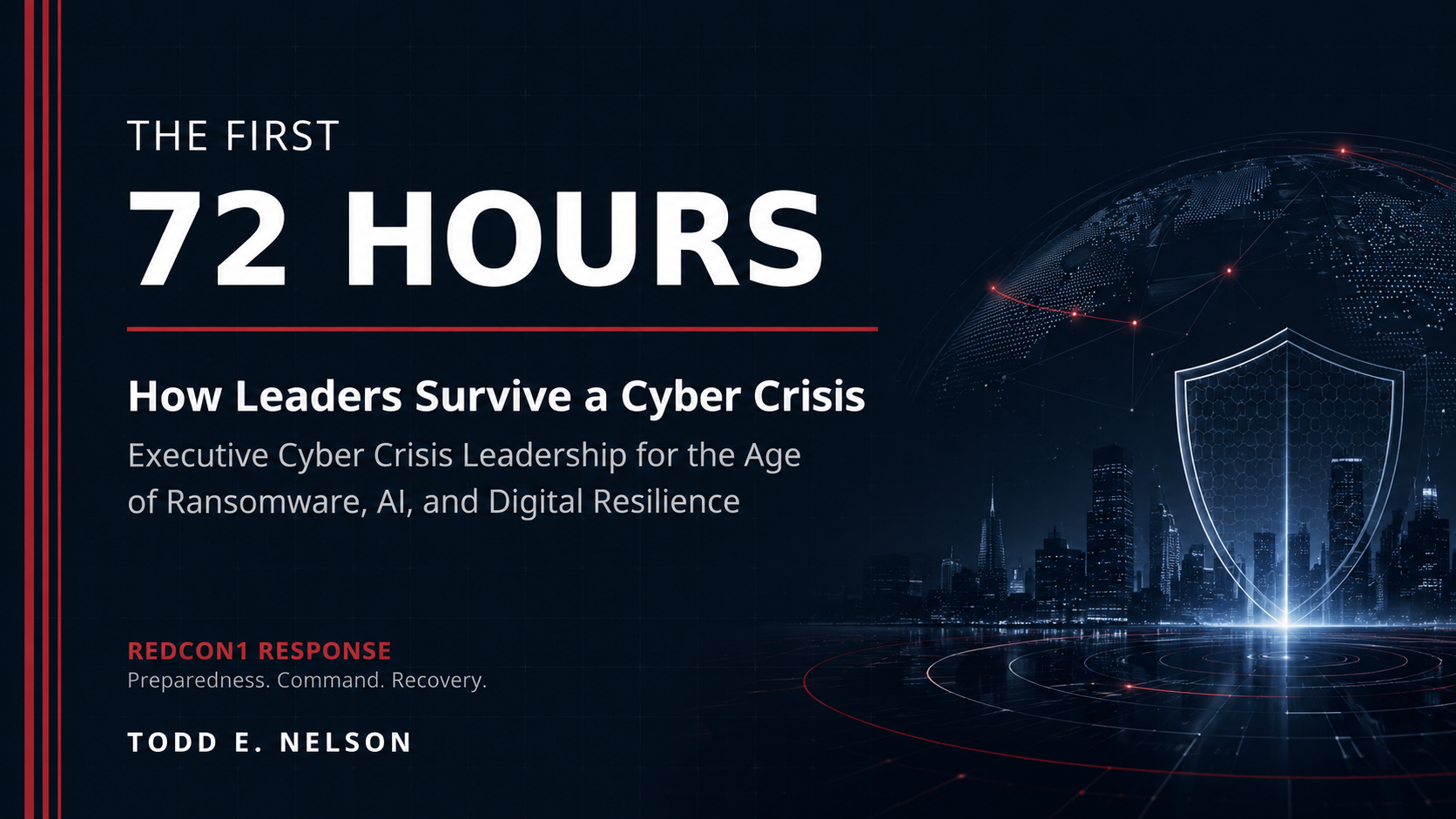
New Book Available
A practical executive guide to the leadership decisions, communication risks, evidence priorities, business continuity issues, and recovery choices that define the first seventy-two hours of a serious cyber incident.
Start small with a fixed-fee QuickScan or build a broader readiness program.
A fixed-fee readiness assessment that gives leadership a clear view of incident response, ransomware readiness, communication gaps, and recovery assumptions.
Learn MoreA deeper review of ransomware response, backup assumptions, executive decisions, third-party dependencies, and recovery priorities.
Learn MorePractical, role-based playbooks your team can use under pressure instead of generic policy language.
Learn MoreA facilitated exercise that tests decision-making, escalation, communications, and recovery assumptions.
Learn MoreImprove alert triage, escalation, ownership, reporting, and response workflows without immediately buying more tools.
Learn MoreOngoing executive advisory support for cyber readiness, incident planning, and security operations maturity.
Learn MoreA focused fixed-fee assessment designed to help leadership understand where the organization stands before a cyber incident occurs. Delivered in 5 business days.

Cyber Readiness QuickScan
Clear, practical deliverables that help leadership understand where readiness may break down, who owns the critical decisions, and what should be prioritized next.
01
A leadership-level snapshot of your current readiness posture, including visible strengths, high-risk gaps, and the areas most likely to create delay, confusion, or business disruption during the first seventy-two hours.
02
A practical map of the decisions that matter under pressure: containment authority, legal escalation, insurance coordination, communications approval, vendor involvement, recovery sequencing, and board reporting.
03
A focused, executive-ready plan that prioritizes the highest-impact readiness improvements first, assigns clear owners, and gives leadership a realistic path to reduce incident confusion before a real event occurs.
Free Executive Resource
Cyber crisis readiness is leadership readiness. This checklist helps executives and incident leaders quickly assess whether the organization is prepared to make the decisions that matter most during the first seventy-two hours of a serious cyber incident.
Most organizations already have security tools, vendors, insurance policies, and response plans. The real test is whether leadership can turn those assets into coordinated action when facts are incomplete, pressure is high, and business operations are at risk.
Inside the checklist
Coming Next
The First 72 Hours course is being built as a practical training experience for executives, founders, board members, risk leaders, IT leaders, and security leaders who want to strengthen cyber crisis decision-making before an incident occurs.
This course will expand the concepts from the book into guided lessons, readiness exercises, workbook materials, leadership scenarios, and practical tools for governing the first seventy-two hours of a serious cyber incident.
It is designed for leaders who need to understand what decisions must be made, who should own them, how to preserve evidence, how to coordinate legal and insurance stakeholders, how to communicate under uncertainty, and how to restore operational trust.
Recommended path
RedCon1 Response is designed to meet organizations at different stages of readiness. Start with a practical resource, deepen your understanding through the book and course, then engage directly when your leadership team is ready to test assumptions, build playbooks, or improve operational readiness.
Quickly assess whether your leadership team is prepared for the decisions that matter most during the first seventy-two hours.
Download the ChecklistUnderstand the leadership framework behind cyber crisis readiness and the business decisions that shape response outcomes.
Buy on AmazonGet notified when the guided course opens, including workbook materials, readiness exercises, and practical implementation tools.
Join the WaitlistDiscuss your organization’s readiness gaps, tabletop needs, ransomware assumptions, or executive response model.
Book a Cyber Readiness CallWhat I Build
The same judgment that runs an incident drives what I build: human-governed systems for the two hardest halves of a cyber crisis — the decision to contain, and the path back to recovery — plus a public lab where the thinking is on display. Working proof of how I approach the problem. Not slideware. Software.
01
Design-partner stageAgentic containment governed by real decision intelligence. It acts at machine speed, isolating threat and scoring containment options; while a live dependency-graph impact engine weighs every action two ways: the risk of acting now against the risk of waiting. Decision authority, first-class evidence preservation, and a tamper-evident ledger keep autonomous action from ever outrunning human judgment in high-consequence incidents — no live action without human approval, and it fails closed.
≈ 24,000 lines · 540+ passing safety tests · 104-model architecture
02
In developmentThe recovery and resilience counterpart to ContainmentIQ, built on the same live dependency graph. The concept turns containment outcomes into sequenced recovery — ordering restoration by business impact and system interdependency rather than guesswork, with evidence-backed readiness that shows what is safe to bring back and when. Executive visibility tracks recovery posture in real time, while agentic, self-healing recovery proposes and stages restorative actions that stay human-gated at every step. Post-incident, it folds the response into structured, reusable learning — the goal is recovery confidence, not static documentation.
03
Live demo · PublicThe open, public demonstration behind ContainmentIQ: triage, blast-radius mapping, scored containment options, an audit-ready decision ledger, and an executive brief. The principle is simple — agents recommend; humans authorize.
Start with a 30-minute Cyber Readiness Call. We’ll identify your highest-priority gaps, recommend the right starting point, and provide clear next steps.
Book a Cyber Readiness CallRedCon1 Response is also developing practical cyber resiliency simulation concepts that help organizations test readiness assumptions before a real incident occurs.